 Add to Chrome
 Add to Firefox
 Add to Edge
Continuous Angular Power Spectrum Recovery From Channel Covariance via Chebyshev Polynomials
Dec 30, 2025
This paper proposes a Chebyshev polynomial expansion framework for the recovery of a continuous angular power spectrum (APS) from channel covariance. By exploiting the orthogonality of Chebyshev polynomials in a transformed domain, we derive an exact series representation of the covariance and reformulate the inherently ill-posed APS inversion as a finite-dimensional linear regression problem via truncation. The associated approximation error is directly controlled by the tail of the APS's Chebyshev series and decays rapidly with increasing angular smoothness. Building on this representation, we derive an exact semidefinite characterization of nonnegative APS and introduce a derivative-based regularizer that promotes smoothly varying APS profiles while preserving transitions of clusters. Simulation results show that the proposed Chebyshev-based framework yields accurate APS reconstruction, and enables reliable downlink (DL) covariance prediction from uplink (UL) measurements in a frequency division duplex (FDD) setting. These findings indicate that jointly exploiting smoothness and nonnegativity in a Chebyshev domain provides an effective tool for covariance-domain processing in multi-antenna systems.

Affine-Projection Recovery of Continuous Angular Power Spectrum: Geometry and Resolution
Dec 29, 2025This paper considers recovering a continuous angular power spectrum (APS) from the channel covariance. Building on the projection-onto-linear-variety (PLV) algorithm, an affine-projection approach introduced by Miretti \emph{et. al.}, we analyze PLV in a well-defined \emph{weighted} Fourier-domain to emphasize its geometric interpretability. This yields an explicit fixed-dimensional trigonometric-polynomial representation and a closed-form solution via a positive-definite matrix, which directly implies uniqueness. We further establish an exact energy identity that yields the APS reconstruction error and leads to a sharp identifiability/resolution characterization: PLV achieves perfect recovery if and only if the ground-truth APS lies in the identified trigonometric-polynomial subspace; otherwise it returns the minimum-energy APS among all covariance-consistent spectra.
Near-Field Position and Orientation Tracking With Hybrid ELAA Architecture
Dec 19, 2025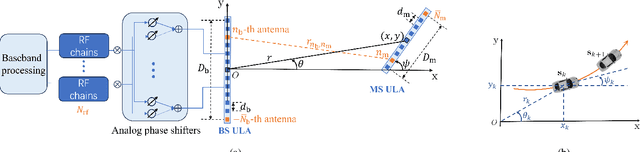
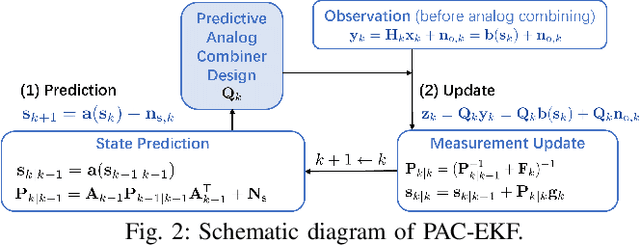
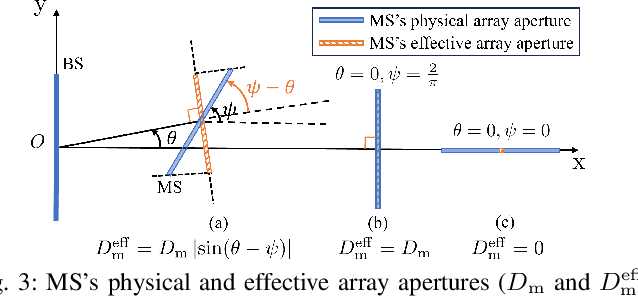
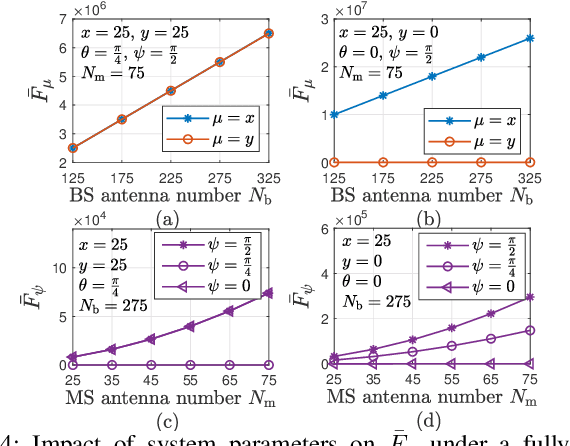
This paper investigates near-field (NF) position and orientation tracking of a multi-antenna mobile station (MS) using an extremely large antenna array (ELAA)-equipped base station (BS) with a limited number of radio frequency (RF) chains. Under this hybrid array architecture, the received uplink pilot signal at the BS is first combined by analog phase shifters, producing a low-dimensional observation before digital processing. Such analog compression provides only partial access to the ELAA measurement, making it essential to design an analog combiner that can preserve pose-relevant signal components despite channel uncertainty and unit-modulus hardware constraints. To address this, we propose a predictive analog combining-assisted extended Kalman filter (PAC-EKF) framework, where the analog combiner can leverage the temporal correlation in the MS pose variation to capture the most informative signal components predictively. We then analyze fundamental performance limits via Bayesian Cramér-Rao bound and Fisher information matrix, explicitly quantifying how the analog combiner, array size, signal-to-noise ratio, and MS pose influence the pose information contained in the uplink observation. Building on these insights, we develop two methods for designing a low-complexity analog combiner. Numerical results show that the proposed predictive analog combining approach significantly improves tracking accuracy, even with fewer RF chains and lower transmit power.
Trajectory Design for UAV-Assisted Logistics Collection in Low-Altitude Economy
Nov 10, 2025Low-altitude economy (LAE) is rapidly emerging as a key driver of innovation, encompassing economic activities taking place in airspace below 500 meters. Unmanned aerial vehicles (UAVs) provide valuable tools for logistics collection within LAE systems, offering the ability to navigate through complex environments, avoid obstacles, and improve operational efficiency. However, logistics collection tasks involve UAVs flying through complex three-dimensional (3D) environments while avoiding obstacles, where traditional UAV trajectory design methods,typically developed under free-space conditions without explicitly accounting for obstacles, are not applicable. This paper presents, we propose a novel algorithm that combines the Lin-Kernighan-Helsgaun (LKH) and Deep Deterministic Policy Gradient (DDPG) methods to minimize the total collection time. Specifically, the LKH algorithm determines the optimal order of item collection, while the DDPG algorithm designs the flight trajectory between collection points. Simulations demonstrate that the proposed LKH-DDPG algorithm significantly reduces collection time by approximately 49 percent compared to baseline approaches, thereby highlighting its effectiveness in optimizing UAV trajectories and enhancing operational efficiency for logistics collection tasks in the LAE paradigm.
Blind MIMO Semantic Communication via Parallel Variational Diffusion: A Completely Pilot-Free Approach
Oct 30, 2025In this paper, we propose a novel blind multi-input multi-output (MIMO) semantic communication (SC) framework named Blind-MIMOSC that consists of a deep joint source-channel coding (DJSCC) transmitter and a diffusion-based blind receiver. The DJSCC transmitter aims to compress and map the source data into the transmitted signal by exploiting the structural characteristics of the source data, while the diffusion-based blind receiver employs a parallel variational diffusion (PVD) model to simultaneously recover the channel and the source data from the received signal without using any pilots. The PVD model leverages two pre-trained score networks to characterize the prior information of the channel and the source data, operating in a plug-and-play manner during inference. This design allows only the affected network to be retrained when channel conditions or source datasets change, avoiding the complicated full-network retraining required by end-to-end methods. This work presents the first fully pilot-free solution for joint channel estimation and source recovery in block-fading MIMO systems. Extensive experiments show that Blind-MIMOSC with PVD achieves superior channel and source recovery accuracy compared to state-of-the-art approaches, with drastically reduced channel bandwidth ratio.
Holographic Communication via Recordable and Reconfigurable Metasurface
Jun 24, 2025Holographic surface based communication technologies are anticipated to play a significant role in the next generation of wireless networks. The existing reconfigurable holographic surface (RHS)-based scheme only utilizes the reconstruction process of the holographic principle for beamforming, where the channel sate information (CSI) is needed. However, channel estimation for CSI acquirement is a challenging task in metasurface based communications. In this study, inspired by both the recording and reconstruction processes of holography, we develop a novel holographic communication scheme by introducing recordable and reconfigurable metasurfaces (RRMs), where channel estimation is not needed thanks to the recording process. Then we analyze the input-output mutual information of the RRM-based communication system and compare it with the existing RHS based system. Our results show that, without channel estimation, the proposed scheme achieves performance comparable to that of the RHS scheme with perfect CSI, suggesting a promising alternative for future wireless communication networks.
Array Partitioning Based Near-Field Attitude and Location Estimation
Apr 23, 2025This paper studies a passive source localization system, where a single base station (BS) is employed to estimate the positions and attitudes of multiple mobile stations (MSs). The BS and the MSs are equipped with uniform rectangular arrays, and the MSs are located in the near-field region of the BS array. To avoid the difficulty of tackling the problem directly based on the near-field signal model, we establish a subarray-wise far-field received signal model. In this model, the entire BS array is divided into multiple subarrays to ensure that each MS is in the far-field region of each BS subarray. By exploiting the angles of arrival (AoAs) of an MS antenna at different BS subarrays, we formulate the attitude and location estimation problem under the Bayesian inference framework. Based on the factor graph representation of the probabilistic problem model, a message passing algorithm named array partitioning based pose and location estimation (APPLE) is developed to solve this problem. An estimation-error lower bound is obtained as a performance benchmark of the proposed algorithm. Numerical results demonstrate that the proposed APPLE algorithm outperforms other baseline methods in the accuracy of position and attitude estimation.
Generative Semantic Communications: Principles and Practices
Apr 21, 2025Semantic communication leverages artificial intelligence (AI) technologies to extract semantic information from data for efficient transmission, theraby significantly reducing communication cost. With the evolution towards artificial general intelligence (AGI), the increasing demands for AGI services pose new challenges to semantic communication. In response, we propose a new paradigm for AGI-driven communications, called generative semantic communication (GSC), which utilizes advanced AI technologies such as foundation models and generative models. We first describe the basic concept of GSC and its difference from existing semantic communications, and then introduce a general framework of GSC, followed by two case studies to verify the advantages of GSC in AGI-driven applications. Finally, open challenges and new research directions are discussed to stimulate this line of research and pave the way for practical applications.
Score-Based Turbo Message Passing for Plug-and-Play Compressive Image Recovery
Mar 28, 2025
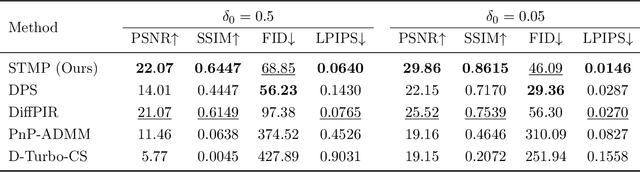
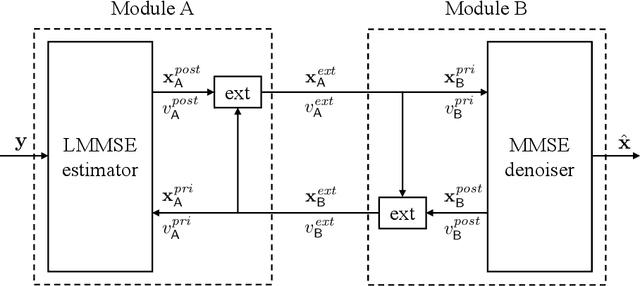
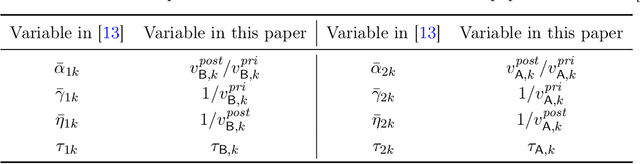
Message passing algorithms have been tailored for compressive imaging applications by plugging in different types of off-the-shelf image denoisers. These off-the-shelf denoisers mostly rely on some generic or hand-crafted priors for denoising. Due to their insufficient accuracy in capturing the true image prior, these methods often fail to produce satisfactory results, especially in largely underdetermined scenarios. On the other hand, score-based generative modeling offers a promising way to accurately characterize the sophisticated image distribution. In this paper, by exploiting the close relation between score-based modeling and empirical Bayes-optimal denoising, we devise a message passing framework that integrates a score-based minimum mean squared error (MMSE) denoiser for compressive image recovery. This framework is firmly rooted in Bayesian formalism, in which state evolution (SE) equations accurately predict its asymptotic performance. Experiments on the FFHQ dataset demonstrate that our method strikes a significantly better performance-complexity tradeoff than conventional message passing, regularized linear regression, and score-based posterior sampling baselines. Remarkably, our method typically requires less than 20 neural function evaluations (NFEs) to converge.
Traversing Distortion-Perception Tradeoff using a Single Score-Based Generative Model
Mar 26, 2025The distortion-perception (DP) tradeoff reveals a fundamental conflict between distortion metrics (e.g., MSE and PSNR) and perceptual quality. Recent research has increasingly concentrated on evaluating denoising algorithms within the DP framework. However, existing algorithms either prioritize perceptual quality by sacrificing acceptable distortion, or focus on minimizing MSE for faithful restoration. When the goal shifts or noisy measurements vary, adapting to different points on the DP plane needs retraining or even re-designing the model. Inspired by recent advances in solving inverse problems using score-based generative models, we explore the potential of flexibly and optimally traversing DP tradeoffs using a single pre-trained score-based model. Specifically, we introduce a variance-scaled reverse diffusion process and theoretically characterize the marginal distribution. We then prove that the proposed sample process is an optimal solution to the DP tradeoff for conditional Gaussian distribution. Experimental results on two-dimensional and image datasets illustrate that a single score network can effectively and flexibly traverse the DP tradeoff for general denoising problems.